Case study · Miami service directory
LocalWork begins with the businesses already doing the work.
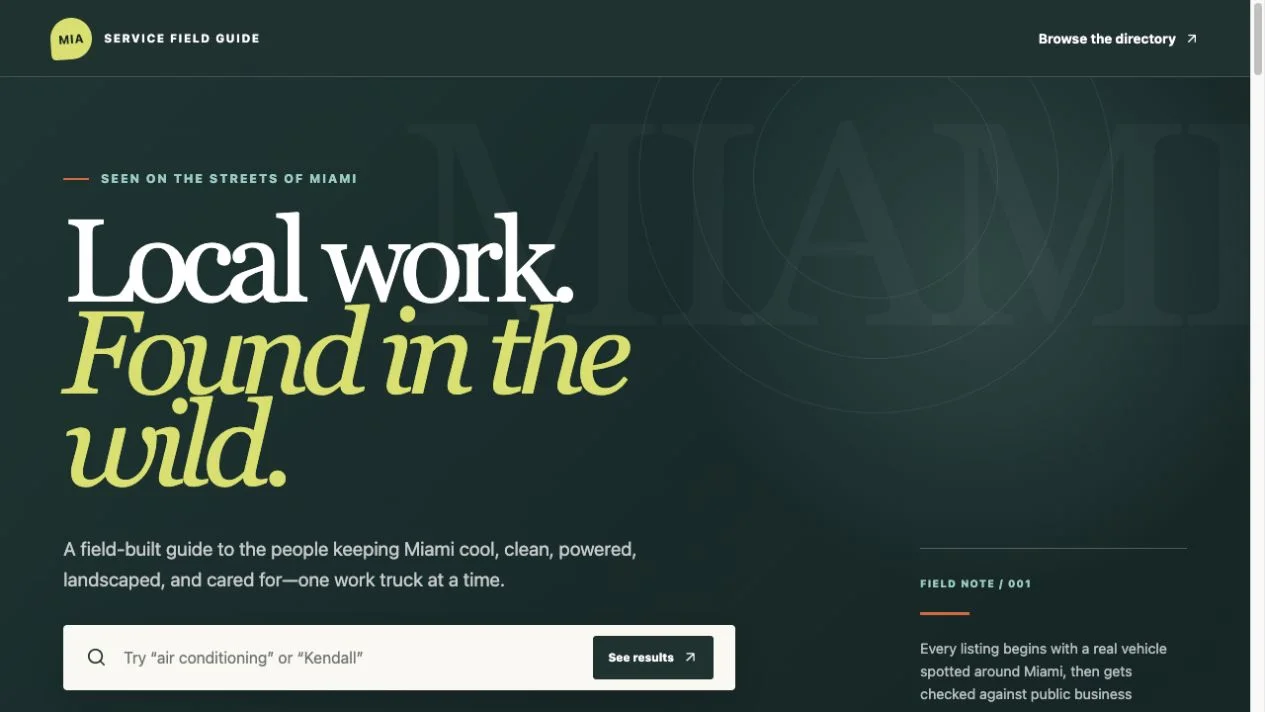
A Miami service field guide that starts with work vehicles observed around the city, researches the businesses against public sources, and turns the findings into a useful searchable directory.
The problem
Local service discovery is often broad, noisy, and detached from place.
The signal is already outside
Across Miami, work vehicles reveal businesses actively showing up for electrical, plumbing, landscaping, cleaning, repair, and other local service work.
The information is fragmented
A name on a truck is a useful starting point, but contact details, trade, and service area still need to be checked and organized before someone can act on them.
More listings are not automatically better
The product favors a smaller researched guide over an indiscriminate directory whose volume obscures where the information came from.
Product decisions
Use field observation as an input, not as the final claim.
Start from visible local work
A work truck observed in Miami establishes the first signal: this is a service business operating in the physical city, not simply a name returned by a generic search.
Research before publishing
The business is then checked against public sources so its identity, trade, contact path, and service information can be represented more usefully.
Structure around the search decision
People can search and filter by trade, service area, and contact method instead of scanning a flat collection of names.
Keep the interface direct
The React application emphasizes finding a relevant business and reaching its public contact path rather than surrounding the directory with unrelated features.
The workflow
From a field sighting to a useful directory entry.
- Observe. A service-business vehicle is encountered while operating around Miami.
- Identify. The visible business name and service clues establish the research starting point.
- Check. Public sources are used to verify and expand the business details available for the guide.
- Structure. Trade, service-area, and contact information are normalized into searchable fields.
- Discover. A visitor searches or filters the guide and follows the business’s public contact path.
Trust and provenance
A directory is only useful when its inputs remain legible.
Grounded discovery
The collection begins with businesses visibly connected to work in the local environment rather than a bulk list assembled without Miami context.
Public-source checks
Observation prompts research; it does not replace it. Published details are assembled from information the business makes public.
Honest scale
At the time of this case study, the structured public data contains 23 listings. That is a current snapshot, not a claim of complete market coverage.
What exists now
A working field guide with room to grow carefully.
LocalWork currently provides a React-based directory with search and filters for trade, service area, and contact method. The direction is to broaden useful Miami coverage while preserving the field-observation and public-research method that distinguishes the guide from anonymous directory volume.
Explore the current LocalWork guideTurning scattered signals into a useful system?